
Japanese Sake: A Short Guide
From centuries-old temple breweries to a flight on Banbury Road.
What is sake?
Sake is brewed from rice, water, yeast and koji, a mould that turns rice starch into fermentable sugar. It’s closer to beer in how it’s made, since it’s brewed rather than distilled. Its smooth, wine-like depth is why it’s so good with food. At around 14 to 16%, it’s also stronger than most wines.
A brief history
Rice sake spread across Japan alongside wet-rice farming, more than a thousand years ago. Early records describe a very different drink from today’s, including versions made by chewing rice. By the Nara and Heian periods, sake was being brewed for the imperial court and for religious ceremonies, and temples became some of the most skilled brewers in the country.
Brewing technique advanced steadily over the centuries. By the 16th century, Japanese brewers were gently heating sake to keep it stable, nearly 300 years before pasteurisation was known in Europe. In the Edo period, great brewing districts grew up around the best water and rice, and several of them are still famous today. In the 20th century, rice polishing and brewing technology produced the fragrant, refined styles known as ginjo and daiginjo.
How to read a sake label
Junmai means pure rice sake, with no added brewer’s alcohol. It tends to be fuller and more savoury.
Ginjo means the rice is polished to 60% of its original size or less. It tends to be more fragrant and delicate.
Daiginjo is polished to 50% or less. It tends to be the most elegant and refined.
Nigori means “cloudy”: coarsely filtered sake that is creamy and slightly sweet.
The number on a bottle like Dassai 45 shows how much rice remains after polishing, so 45 means 45% of the grain is left.
How region shapes flavour
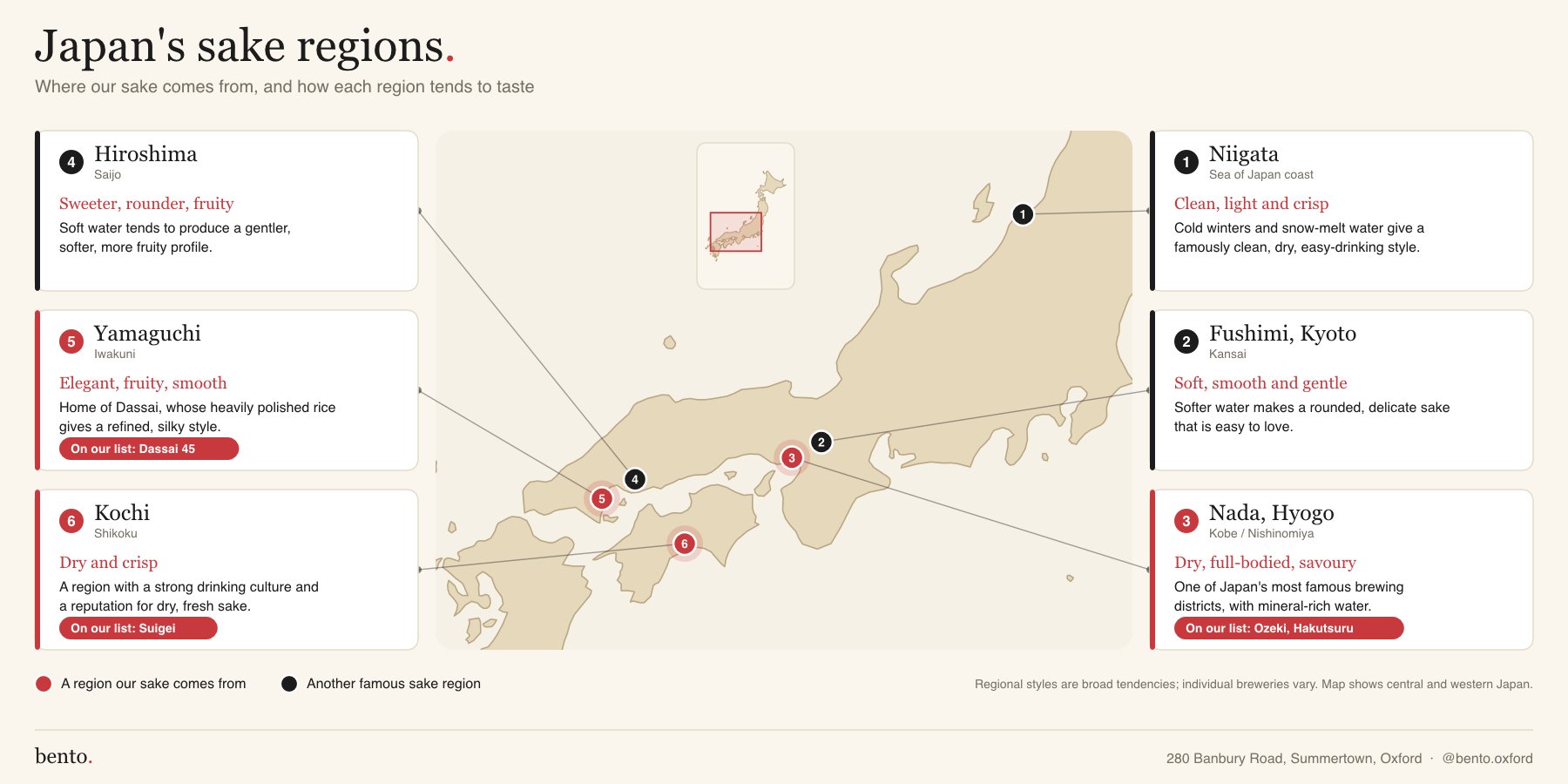
Water, climate and local tradition give each region its own character. These are broad tendencies, and individual breweries vary.
Nada, Hyogo is one of Japan’s most famous brewing districts. Its mineral-rich water traditionally produces dry, full-bodied, savoury sake.
Fushimi, Kyoto has softer water and is known for gentler, smoother, more rounded sake.
Niigata is known for a clean, light, crisp style.
Hiroshima has soft water and tends towards a sweeter, rounder, more fruity profile.
Kochi, on Shikoku, has a strong drinking culture and a reputation for dry, crisp sake.
Yamaguchi is home to Dassai, whose heavily polished rice produces an elegant, fruity, smooth style.
The sake at Bento
Ozeki Tokubetsu Junmai Yamadanishiki is our house sake. It’s made with Yamadanishiki, often called the king of sake rice, and it’s rich and rounded with a long umami finish. It’s excellent chilled or gently warmed, which makes it a good first sake if you’re new to this.
Hakutsuru Junmai Ginjo is flowery and fragrant, with a silky texture. It’s the one to reach for if you like aromatic, easy-drinking drinks.
Suigei Junmai Ginjo is dry and fresh, with mineral and bitter-orange notes. It suits people who prefer crisp, clean flavours.
Dassai 45 Junmai Daiginjo is elegant and polished, with soft fruit and gentle sweetness. It’s our most refined bottle.
Ozeki Nigori is cloudy and creamy with a sweet, rich character. It’s a good dessert sake.
Ozeki Hana Awaka Sparkling is light and lively with delicate sweetness. It works well as an aperitif or a gentle introduction to sake.
Not sure where to start? Try the flight
Our BENTO Sake Flight pairs three sakes in a tasting progression: Ozeki Junmai, Suigei Ginjo and Dassai 45. It moves from savoury and rich to crisp and elegant, so you can taste how style changes from one to the next.
Come and try it: see the full drinks menu or visit us at 276 Banbury Road, Summertown. Bring friends, since sake is made for sharing.